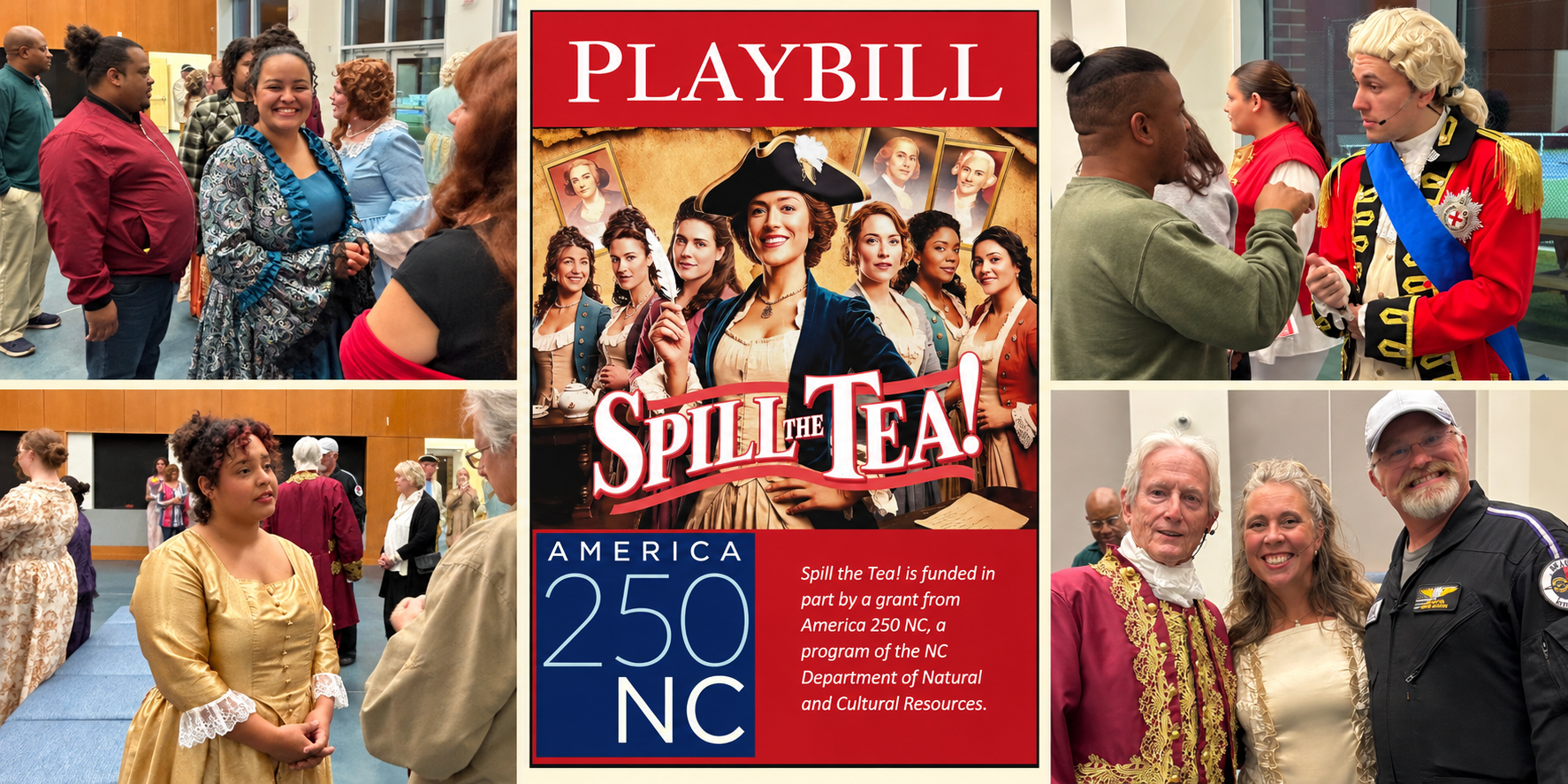
Presented at the John A. Holmes Performing Arts Center, the musical revisited the events surrounding the Edenton Resolves of October 25, 1774, when 51 women publicly expressed their support for the colonial boycott of British goods.
Their declaration, now recognized as one of the earliest organized political actions by women in American history, placed Edenton on the map long before women could vote or hold political office.
At the center of the production is Barker, a woman whose leadership, independence and willingness to challenge the established order helped make the Edenton Tea Party an enduring chapter in American history.
Unlike the more familiar Boston Tea Party, where colonists destroyed British tea in protest, Edenton's women made their statement through a written declaration. Their signatures publicly committed them to supporting the colonial resistance through a boycott of British goods.
It was a bold action at a time when women were largely excluded from formal political participation.
Edwards' production explores that courage while placing the Edenton women's story within the broader struggle for American independence.
The musical opens in a schoolroom before transporting audiences to the 1767 Chowan County Courthouse, the Penelope Barker House, London and Revolutionary War battlefields.
The two-act production features scenes depicting the signing of the Edenton Resolves, correspondence between Penelope and Thomas Barker, British aristocrats reacting to colonial unrest and the military conflicts that ultimately secured American independence.
Musical numbers include “Spill the Tea,” “Be Strong, Be Bold,” “Letters from Across the Sea,” “Rise and Be Heard,” and “Find Your Fire.”
One particularly pointed number, “Next, They'll Be Wanting to Vote,” uses the perspective of British authorities to underscore the social and political expectations that women such as Barker challenged.
The musical also ventures beyond Edenton, depicting the battles of Paoli, Waxhaws, Camden and Yorktown, along with scenes featuring George Washington and King George III.
A Revolutionary War suite titled “The Price of Liberty” and a number called “NO KINGS” help carry the production toward its conclusion.
The result is a theatrical interpretation of history that connects the courage displayed in Edenton with the larger struggle for independence.
The production brings together an extensive company of local and regional performers, including experienced actors, musicians, dancers and students.
Alana Jones portrays Penelope Barker, while Alex Kehayes takes on the role of Judge Hawkins and Joe Manley portrays Lord Sandwich. Brendan Hanks appears as both Jack Jones and George Washington.
Christopher Josiah Doss, known professionally as CJ, portrays Lawrence Thomas and King George III. A graduate of James Madison University with a degree in musical theater, Doss has appeared in productions including “Newsies,” “Memphis” and “Footloose.” His participation is through the courtesy of Actors' Equity Association.
Hanks, who earned a Bachelor of Fine Arts in Musical Theatre Performance from Utah Valley University, brings professional performance experience, including work aboard the MSC Virtuosa.
Jones returns to the stage after nearly a decade away from performing. Her background includes musical theater and independent music, and she has expressed a particular interest in storytelling through performance.
Other cast members include Christy Caison, Trish Berg Bartel, Kimberly Dunlow, Makayla Jones, Maren Dix, Bella Smith, Kevin Spragins, Sharon Cole, Samantha Burgess, Betsabe Sayers and Marissa Laffely.
Young performers are also featured throughout the production, helping connect the historic events of 1774 with a new generation learning about Edenton's place in American history.
The combination of experienced performers and younger cast members gives the production a distinctly community-centered character.
Bringing history to life
Behind the scenes, the musical represents a substantial creative undertaking.
Edwards, who wrote the book and directed the production, also shares musical and producing credits with Will Raucci. Sergio Gutierrez is credited with music, and Colleen Brown joins the producing team.
Trish Berg Bartel provided additional direction, Monica Williams serves as musical director, and Marissa Fox is choreographer.
Keith Dix handled sound and video design, while Bartel and Nolan Porter were responsible for lighting design. Raucci designed the sets, and Brown oversees costume design.
The production also relies on an extensive technical crew, costume assistants, stage management personnel and volunteers.
That collective effort reflects one of the production's central themes: history is preserved not simply through documents and monuments, but through people willing to tell its stories.
Community support has also played an important role in bringing the musical to the stage.
Sponsors include Colony Tire & Service, Regulator Marine and Dr. and Mrs. Alex Kehayes. The production has also benefited from assistance from the North Carolina Department of Natural and Cultural Resources, Visit Edenton, Arts of the Albemarle and numerous individuals and organizations.
A story still relevant today
Although the musical takes audiences back more than two centuries, the questions it raises remain familiar.
Who has a voice in government? What responsibilities do citizens have when they disagree with those in authority? And how can ordinary individuals influence events far beyond their own communities?
For Penelope Barker and the women who signed the Edenton Resolves, those questions were not theoretical.
Their declaration carried social and economic implications, particularly in a colonial society where political authority rested overwhelmingly with men.
Their action was not a demand for women's suffrage, but it demonstrated that women could organize, take public positions and participate meaningfully in the political affairs of their time.
By placing Barker's story alongside scenes of British authority, colonial resistance and the Revolutionary War, “Spill the Tea!” gives audiences a broader understanding of the world in which the Edenton women acted.
It also offers an opportunity to recognize the courage of women whose contributions to American independence have not always received the attention afforded to the nation's military and political leaders.
As the United States commemorates the 250th anniversary of its founding, Edenton's historic role in the struggle for independence carries particular significance.
The Edenton Tea Party was a local event with national implications, demonstrating that resistance to British policies extended beyond colonial assemblies and military organizations into homes and communities.
“Spill the Tea!” brings that history out of the textbooks and onto the stage, where the personalities, conflicts and convictions of the Revolutionary era can be experienced through music and performance.
And at the heart of it all stands Penelope Barker, whose willingness to lead a group of women in a public act of political resistance helped establish Edenton's place in the nation's history.
Two hundred and fifty-two years later, her story is still being told — and, through this original musical, sung.