
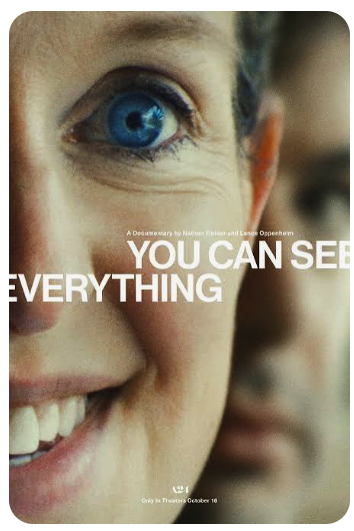
You Can See Everything, currently playing at the Taylor, is a recently released documentary that follows disgraced Theranos founder Elizabeth Holmes during the 34 days leading up to her 11-year prison sentence. Filmed in secret, the documentary follows Holmes and her partner, Billy Evans, at their San Diego beach rental, beginning in 2023.
Holmes, a former businesswoman, founded the blood-testing startup Theranos after dropping out of Stanford at age 19. The company claimed to have developed revolutionary technology capable of performing hundreds of medical tests using just a tiny pinprick of blood. At its peak, Theranos was valued at $9 billion, and Holmes was celebrated as the world's youngest self-made female billionaire. However, a Wall Street Journal investigation revealed that the technology did not work as advertised. In 2022, Holmes was convicted of wire fraud and conspiracy to defraud investors.
The film is directed by Nathan Fielder. Those more familiar with contemporary comedy and television will recognize his name from some of his previous work. Fielder is a Canadian comedian, writer, director, and producer known for his deadpan delivery and deliberately awkward social encounters. Among his best-known creations is Nathan for You, a docu-reality series in which he plays a socially awkward, fictionalized version of himself, offering unconventional—and often disastrous—business advice to struggling companies.
Given Fielder's reputation, many observers found it surprising that Holmes would agree to let him into her home to film the documentary. Nevertheless, the film has become both a critical and box-office success since its release earlier this month.
Holmes and Fielder are at the center of the film, appearing in nearly every scene. The deliberate close-ups of their faces capture subtle reactions to the questions asked and the answers given during their conversations. Little time is devoted to recounting Theranos's history or reviewing the events leading up to Holmes's conviction. Instead, Fielder seems intent on getting honest answers from Holmes about her role in what became one of the largest corporate fraud scandals in Silicon Valley history.
Was she aware that her proprietary technology was not working and was unlikely ever to work as promised? Did she rely on modified third-party analyzers and manually processed blood samples? Did she falsify data presented to the FDA and investors, and stage demonstrations of a product that did not perform as advertised?
Throughout the interviews, Holmes remains quietly but firmly committed to her belief in the technology and her own innocence—even going so far as to suggest that she and her colleagues were working on what would be Theranos II. Fielder, meanwhile, appears increasingly skeptical, leaving the viewer to wonder whether Holmes is deliberately deceiving him or has somehow convinced herself that her version of events is true.
Ultimately, the audience is left to decide whether Holmes genuinely believes what she is saying. There is also the lingering question of who is manipulating whom. Was Holmes using Fielder's extended presence in her home to maintain some degree of control over the narrative? Or was Fielder manipulating Holmes, using the unusual access he had gained to create a documentary that would succeed at the box office?
Whatever the answers, the film has proved to be a surprising commercial success, reportedly earning more than $50 million during its first two weeks of release. It is only the third non-music documentary in history to surpass the $50 million mark at the North American box office, placing it among the most successful theatrical documentaries in recent decades. Clearly, there remains tremendous public interest in the story of a brilliant 19-year-old Stanford student who set out to revolutionize the biotechnology industry, only to become the central figure in one of the most notorious corporate scandals of our time.
So, is this a film worth spending nearly three hours watching, particularly when much of the running time involves little more than two people talking to one another? Possibly. Were you fascinated by the Theranos story when it first broke nearly a decade ago? Did you follow Holmes's trial and develop your own opinion about her guilt or innocence? Do you enjoy films, whether fictional or based on actual events, that explore scandals at the highest levels of corporate America? If so, you will probably find this offering worthwhile.
The principal characters—Holmes, Fielder, and, to a lesser extent, Holmes's partner and the father of her two children, Billy Evans—are absorbing, at times almost riveting, in their largely raw and unrehearsed interactions.
Such has been the reception to the film that its distributor is mounting a major Oscar campaign, with particular attention being directed toward the categories of Best Picture, Best Documentary Feature, Best Director, and Best Cinematography. An interesting additional element is the appearance of Amanda Seyfried, who previously portrayed Holmes in the television series The Dropout. Fielder brings her back for a handful of brief, scripted reenactments, including scenes depicting Holmes in prison that could not be filmed with Holmes herself. Although Seyfried's appearances are relatively limited, they provide an unusual connection between the documentary and the earlier dramatic treatment of the Theranos story.
Ultimately, You Can See Everything begins as an unconventional examination of Holmes's final days of freedom before evolving into something of a surreal deconstruction of documentary filmmaking itself. It is less concerned with revisiting the familiar details of the Theranos scandal than with exploring the nature of truth, self-deception, and manipulation. If you enjoy challenging cinema that leaves you thinking long after the credits roll, this one may be well worth your time. This isn't simply another retelling of the Theranos scandal. It is an examination of the relationship between filmmaker and subject, and the possibility that both may be attempting to control the truth as it is presented to the audience.