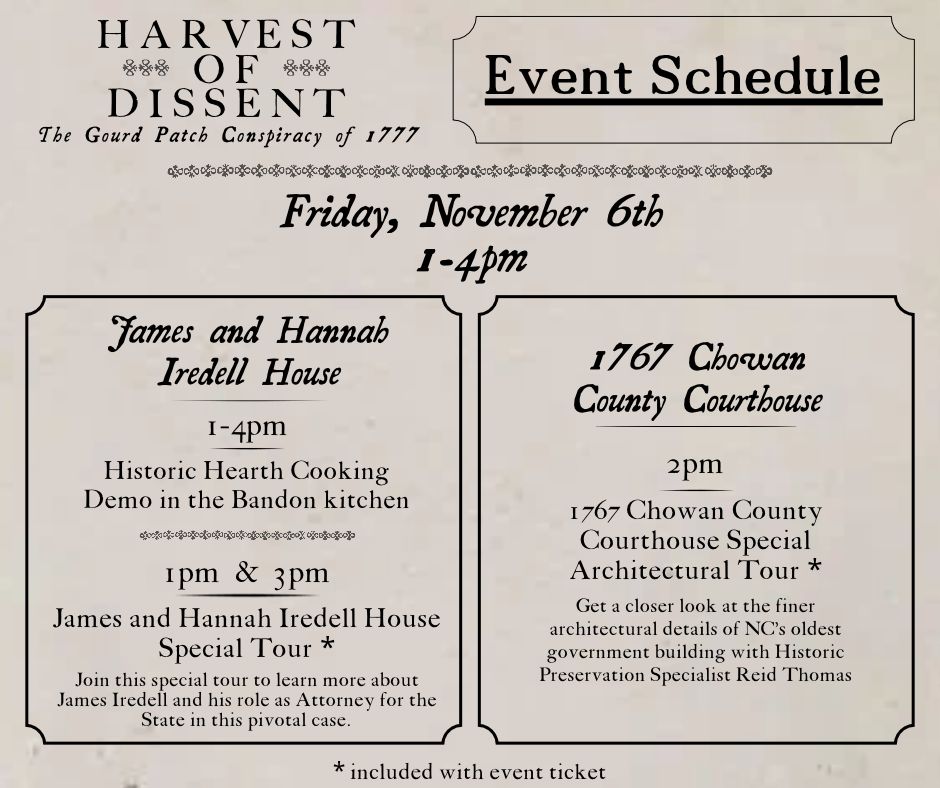
Historic Edenton will revisit a plot to kill North Carolina’s governor when Harvest of Dissent opens Friday, Nov. 6, from 1 to 4 p.m. and continues Saturday, Nov. 7, from 10 a.m. to 4 p.m. The two-day program brings visitors to the 1767 Chowan County Courthouse, where a Martin County farmer stood trial for treason, and to the James and Hannah Iredell House, where interpreters will portray Edenton residents living through the uncertainty of the American Revolution. NC DNCR
On Friday, ticket holders can take a themed tour of the Iredell House, explore the architecture of the courthouse and visit the Roanoke River Lighthouse. At the Iredell House on both days, visitors can stop by the historic kitchen, watch demonstrations and pull up a chair in a re-created tavern to talk with interpreters about the case that divided neighbors in 1777.
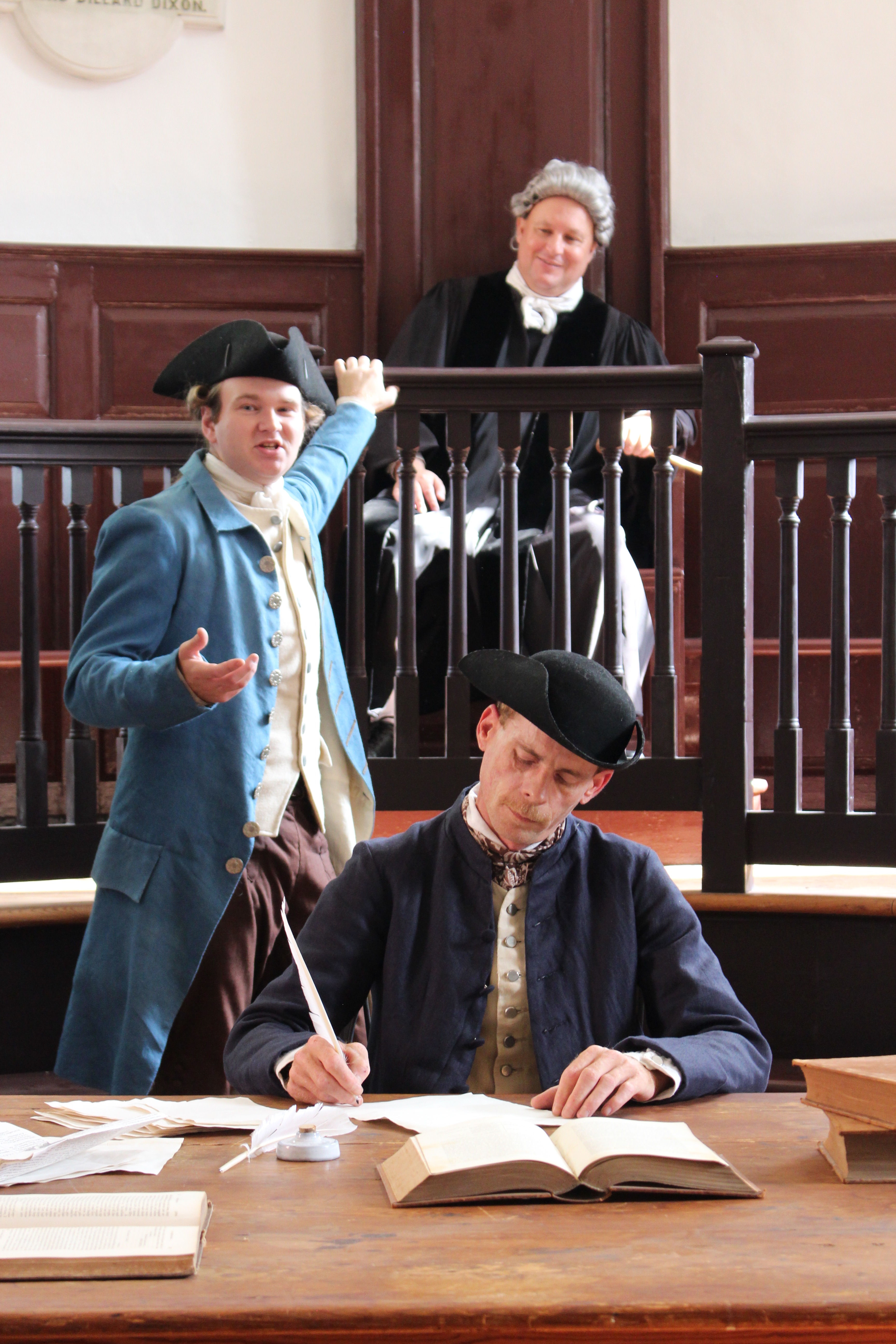
On Saturday, the trial of John Lewelling will be re-created at 11 a.m. and 2 p.m. in the Chowan County Courthouse. Organizers drew on sworn testimony, court orders and letters preserved in the State Archives of North Carolina. Those records tell a story with an unlikely ending. Among the people who helped Lewelling’s wife seek mercy was a neighbor her husband had threatened to kill. At the 1767 Chowan County Courthouse, visitors can take a seat for the treason trial that brought a Martin County farmer before prosecutor James Iredell. The farmer stood accused of plotting to kill North Carolina’s governor. One of the men who later helped his wife plead for mercy was a neighbor the conspirators had threatened to kill
How the conspiracy got its name
In the summer of 1777, as North Carolina’s new government sought oaths of loyalty from its citizens, a group of men in the eastern counties had been swearing an oath of their own. Their organizer, John Lewelling, was a Martin County farmer who had served as a justice of the peace. The conspiracy takes its name from a place where members met, believed to have been a gourd patch near Lewelling’s home in the vicinity of Conetoe Swamp. The precise spot is uncertain. NC DNCR
Religion had helped bring the men together. Lewelling feared that the new government’s willingness to tolerate Catholics threatened the Protestant faith. Members of his society pledged themselves by oath and paid dues to support a lay reader who could lead worship. Lewelling’s son William circulated the society’s document through Martin, Edgecombe, Halifax, Bertie and Tyrrell counties. James Rawlins, a lay Anglican minister from Hyde County, helped recruit members at religious services. The network reached well beyond the neighbors who could gather in one farmer’s field. NC DNCR
By summer, opposition to the military draft had given way to plans for violence. According to testimony collected after the plot unraveled, Lewelling wanted to seize gunpowder at Halifax and capture or kill Gov. Richard Caswell during an expected visit. There was a Chowan County connection even before the case reached Edenton. Lewelling approached David Taylor, a Chowan County slave patroller, about provoking an uprising among enslaved people to draw the militia away. Taylor initially agreed, then reported the scheme to authorities in early June.
The danger was personal. Lewelling suspected that his neighbors James and Nathan Mayo, both supporters of the Patriot cause, had helped bring about arrests. After a meeting at the gourd patch, an armed conspirator waited beside a road James Mayo often traveled. Mayo happened to take another route that night. Caswell, meanwhile, did not arrive in Halifax as expected. About July 16, roughly 30 armed conspirators tried to take the gunpowder stored at Tarboro. Lt. Col. Henry Irwin and the local militia disarmed and arrested them.
Why the case mattered to Edenton
The plot took shape in Martin County. Edenton was where North Carolina had to put its new authority into practice. The General Assembly had defined treason under state law only that May. Lewelling’s trial was the first case heard by the Edenton District Court of Oyer and Terminer after it resumed following the Declaration of Independence. Even the name of the prosecution marked the change. For the first time in the district, the case was brought in the name of “The State” where a colonial prosecution would have named “The King.”
James Iredell, who would later serve on the United States Supreme Court, prosecuted Lewelling. Much of what historians know comes from affidavits prepared for the trial, including statements by men implicated in the plot. Their accounts preserved details as intimate as a threat against a neighbor, though the men giving evidence also had reason to minimize their own roles. On Sept. 20, 1777, the court found Lewelling guilty of high treason. His execution was set for Sept. 30.
Then came the part that makes this story especially worth telling in Edenton. Mary Lewelling sought mercy for her husband, and Nathan Mayo accompanied her. Col. William Williams, another intended victim, also petitioned on Lewelling’s behalf. Their appeals placed a difficult question before the state’s leaders. The legislature had defined treason and the court had convicted the defendant. Who had the authority to spare his life? Some legislators feared that giving a governor the power to pardon would give him too much of the power a king had exercised.
Caswell ultimately pardoned the man accused of plotting against him. North Carolina identifies it as the state’s first gubernatorial pardon. The pardon document has not survived, but Lewelling’s 1794 will provides evidence that he lived many years beyond the date set for his execution. Edenton’s place in the story rests on both outcomes. Its courtroom helped establish what it meant to commit treason against North Carolina, and the sentence handed down there forced the new government to decide who could show mercy in the state’s name.