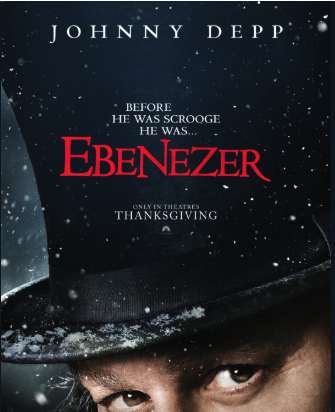
There have been twelve direct, full-length theatrical feature-film adaptations of Charles Dickens' A Christmas Carol. There have also been numerous television adaptations, along with several early silent-film versions running less than 40 minutes. Ebeneezer is the latest entry in the ever-growing Scrooge film library and stars Johnny Depp as the cold-hearted, tight-fisted, emotionally isolated miser who undergoes a profound moral awakening.
While the story remains essentially the same regardless of which film version you happen to see, the treatment of the material can vary considerably depending on the director's vision. No two actors approach Scrooge's journey toward redemption in exactly the same way, so choosing a favorite adaptation often comes down to how you have personally envisioned the character. For me, that distinction has always belonged to Alastair Sim's 1951 portrayal, which I first saw on late-night television as a boy. Sim's ability to skillfully combine the defining elements of Scrooge's character—his wretched, deeply wounded persona and his manic, joyful release at the story's conclusion—made that adaptation the gold standard in my eyes.
There have been other creative attempts at bringing Scrooge to the screen. George C. Scott took the gruff, intimidating approach in 1984, while Patrick Stewart delivered a fierce, intense portrayal in 1999. Both stand out in the annals of Scroogedom, unlike some of the more questionable interpretations of the story.
Take Albert Finney's 1970 version, for example, which was, of all things, a musical. Imagine Scrooge breaking into a solo of "I Hate People": "People are despicable creatures ... good-for-nothing, kickable creatures—I hate people!" If that wasn't curious enough, there was also 1992's The Muppet Christmas Carol. To be certain, The Godfather was a pretty good film, but there are those who might argue that, objectively speaking, the Muppets produced the greatest film of all time. It wasn't perfect, of course. Kermit couldn't interact with Fozzie or Gonzo, and Miss Piggy was confined to a maternal role that didn't quite suit her. Nevertheless, what was initially a somewhat overlooked entry has, more than 30 years later, become a bona fide Christmas classic, readily available on Disney+.
Edward Scissorhands. Jack Sparrow. Willy Wonka. There seems to be no limit to Johnny Depp's range when it comes to film roles. The more offbeat, eccentric, and transformative the character, the more likely Depp is to take it on. He has played conventional, straight-laced characters as well, but those aren't necessarily the roles for which audiences remember him. The same will likely be true if you choose to see Ebenezer. Beneath the heavy old-age prosthetics, weathered Victorian wardrobe, and gaunt silhouette, Depp remains recognizable, even as he adopts the grim, cold demeanor that fits the dreary, fog-shrouded London of 1843. It is an image that may well linger with you long after the credits roll.
Ti West is an American filmmaker best known for writing and directing independent horror films. It should come as no surprise, then, that his adaptation of Ebenezer takes on the atmosphere of a cold, gothic ghost story. There is little of the traditional holiday warmth we might expect from a Christmas film. Instead, we get Victorian gloom. London's streets are shrouded in fog, its cobblestones slick with dampness, and its surroundings steeped in urban despair. The three Spirits who visit Scrooge over the course of the night are not the whimsical guides we may have encountered in other adaptations. These are intrusive, macabre apparitions whose presence inspires dread.
Despite West's darker treatment, the underlying moral arc remains faithful to Dickens. The film is colder and bleaker than your typical holiday fare, but it manages to preserve moments of genuine emotion alongside its ghostly theatrics.
As for the performances, Depp's portrayal of Scrooge has received mixed reactions. Some may find his performance exaggerated, even bordering on cartoonish. Others will appreciate the dark depth and sarcastic wit he brings to the character. Having seen my share of Scrooge portrayals, I think Depp succeeds in making the character his own rather than simply offering another carbon copy of previous interpretations.
I particularly liked how Scrooge's defenses gradually crumble as the Spirits confront him with the events of his past. His eventual embrace of Christmas feels like a genuine transformation rather than a sudden plot twist, and Depp handles that transition convincingly. By the end, Scrooge reconciles with his nephew Fred and, rather than simply offering his downtrodden and mistreated employee, Bob Cratchit, a raise, he makes Cratchit a full business partner.
Most of us are already well acquainted with Dickens' story, but this adaptation takes a darker approach and may be a little intense for younger viewers. Nevertheless, its central themes of redemption, social responsibility, greed versus generosity, family, human connection, and the transformative spirit of Christmas remain firmly intact.
Dickens' Christmas, as reflected in A Christmas Carol, is about much more than a religious observance or a date on the calendar. It is a moral imperative calling for compassion, charity, and goodwill toward our fellow human beings—values that should be practiced throughout the year, not simply celebrated during the holiday season.